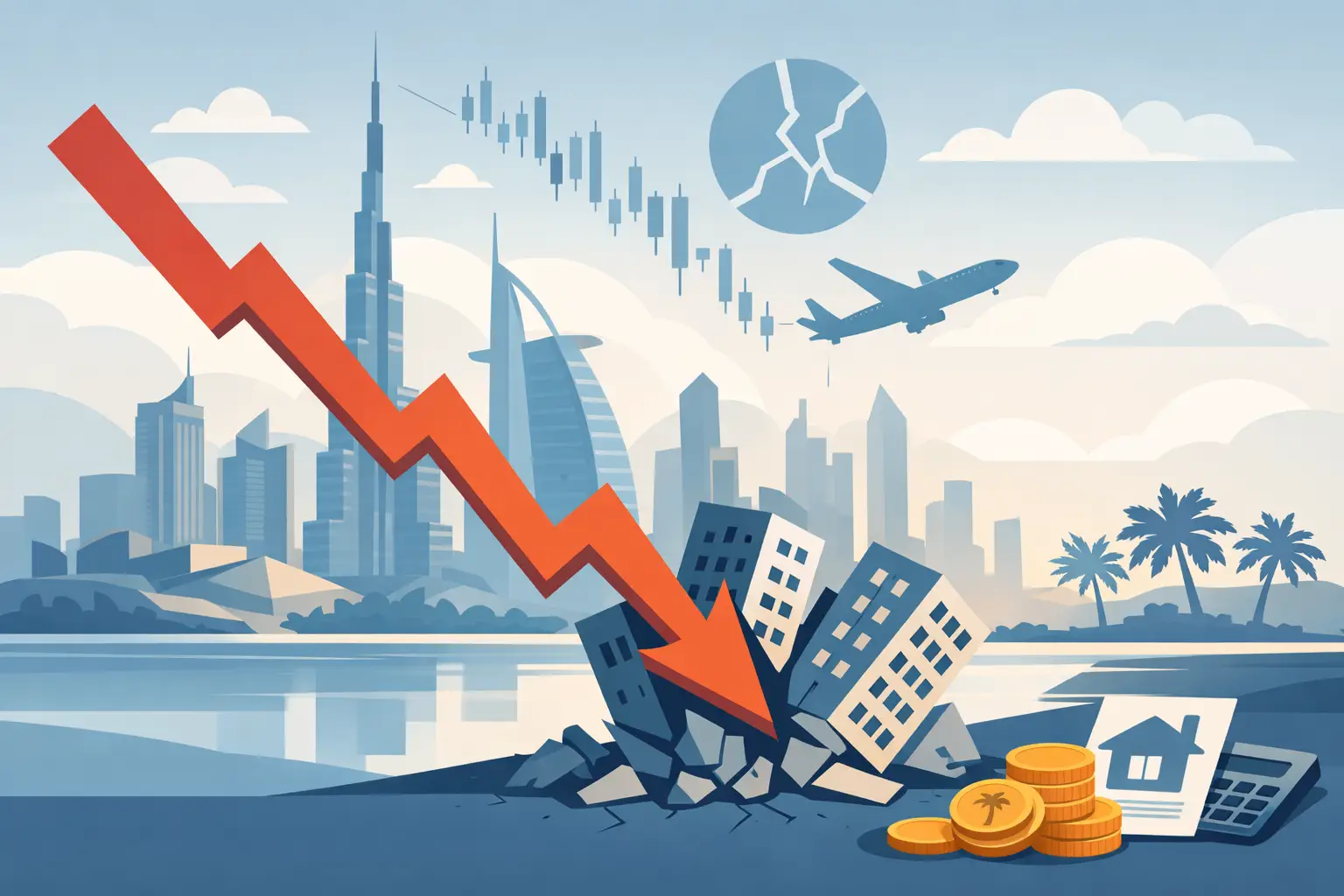
Search interest spikes every time prices climb: is Dubai property market going to crash, or is the market simply moving into a more selective phase? It is the right question to ask, especially for buyers considering a premium home, investors reviewing yields, or overseas clients weighing an off-plan commitment. But the honest answer is not a dramatic yes or no. Dubai is not showing the broad conditions of a sudden market collapse. What it is showing is a market that rewards precision, punishes overpaying, and behaves very differently by segment, location, and asset quality.
That distinction matters. Buyers who treat Dubai as one single market often make poor decisions. Prime waterfront residences, established family communities, short-term rental apartments, and off-plan launches each respond to different demand drivers. A headline about price growth or a warning about oversupply rarely tells the full story. Serious investors need to look beneath the surface.
Is Dubai property market going to crash, or just cool?
A crash usually means rapid, broad-based price declines driven by forced selling, a severe credit problem, weak demand, and a lack of liquidity. That is not the same as a cooling phase. A cooling market can include slower transactions, longer selling periods, more negotiation, and modest price corrections in selected areas.
Dubai today looks far closer to a normalization story than a collapse story. The market has been supported by population growth, business migration, high-net-worth inflows, infrastructure development, and a tax-friendly environment that continues to attract global capital. At the same time, prices in some communities have moved up quickly, which naturally creates concern about whether values have run ahead of fundamentals.
The right reading is this: some pockets may soften, some projects may underperform, and some sellers may need to reset expectations. That is not the same as the entire market crashing.
What usually causes a real estate crash
Property markets tend to break when several risks hit at once. Excessive debt is one. A large volume of speculative buying with weak end-user demand is another. A sharp economic shock, rising financing stress, or a flood of poorly timed supply can add pressure quickly.
Dubai has some exposure to these risks, but not all at the same intensity. Mortgage penetration is lower than in heavily leveraged markets. A meaningful share of transactions are cash-based, which reduces the chance of widespread distress selling. The city also benefits from a diverse buyer base, including international investors, business owners, and end users relocating for lifestyle and tax reasons.
That said, the market is not immune. If supply ramps up too fast in specific districts, or if global liquidity tightens further, weaker projects and average locations can come under pressure. The buyers who suffer most are usually those who buy on momentum alone, without considering handover timing, rental depth, service charges, or future competing inventory.
The real pressure point: supply versus quality demand
If there is one issue worth watching closely, it is future supply. Dubai has an active development pipeline, and off-plan inventory remains a major part of the story. New launches can be attractive, especially when they are well-located, well-branded, and structured around strong payment plans. But volume alone does not guarantee performance.
When too many similar units enter the same micro-market at the same time, price growth can flatten and rental competition can increase. This is particularly relevant in areas where investor-led apartment stock dominates and product differentiation is limited. In those cases, the risk is not necessarily a crash. It is underwhelming returns, slower resale activity, and more pricing pressure at handover.
By contrast, premium communities with limited land, stronger end-user demand, and proven resale depth tend to hold up better. Scarcity still matters. So does build quality. So does the reputation of the developer.
Why Dubai still has strong support
It is difficult to argue for a broad crash while the city continues to attract residents, companies, and international wealth at scale. Dubai has positioned itself as a base for entrepreneurs, executives, remote professionals, and global families seeking security, connectivity, and lifestyle. That supports both rental demand and end-user purchases.
Rental growth over recent cycles has also pushed many residents to consider buying rather than leasing, especially in family-focused communities. For investors, rental yields remain comparatively attractive versus many mature global cities. That yield support helps explain why demand has stayed resilient even as values have risen.
There is also a confidence factor. Buyers are not just purchasing square footage. They are buying into infrastructure, regulation, branding, and long-term city-building. That does not eliminate risk, but it does give Dubai a stronger underlying demand case than markets driven mainly by local wage growth alone.
Is Dubai property market going to crash in the off-plan segment?
This is where nuance matters most. Off-plan does not move as one category. The strongest projects often perform well because they combine location, developer credibility, appealing payment plans, and real end-user or investor demand. The weakest launches struggle because they are generic, overpriced, or entering a crowded pipeline.
For buyers, off-plan risk is less about a dramatic market-wide crash and more about project selection. If you buy into a development with too much surrounding competition, a long handover timeline, and unclear rental demand, your upside can narrow quickly. If you buy into a well-positioned scheme with strong branding and a genuine lifestyle proposition, the outcome can be very different.
This is why experienced advisory matters. Off-plan can create excellent opportunities in Dubai, especially in premium segments, but only when the buying decision is disciplined. The launch brochure is never enough.
What smart buyers should watch now
Instead of asking only whether the market will crash, ask where the risk actually sits. In Dubai, risk is rarely spread evenly. It tends to cluster around overhyped communities, secondary stock with little differentiation, and projects priced for perfect conditions.
Watch time on market. Watch developer launch volume in the same district. Watch whether rents are keeping pace with capital values. Watch service charges, expected handover dates, and how many similar units may compete with yours in two or three years. These are practical signals. They tell you more than dramatic headlines.
Financing costs also matter. Even in a cash-influenced market, mortgage affordability shapes part of the buyer pool. If rates stay elevated, the mid-market can become more price-sensitive. Premium cash buyers are often better insulated, which is one reason prime property can behave differently from the broader market.
Where a correction is more likely than a crash
A correction is always possible, and in some areas it is healthy. Markets that rise quickly often need a pause. That can remove excess speculation, improve negotiating conditions, and create better entry points for long-term buyers.
If a correction comes, it is more likely to appear in overstretched submarkets rather than across every Dubai community at once. Mid-quality apartment inventory in heavily supplied areas may see more pressure than limited premium stock in desirable locations. Off-plan flips may become harder. Resale pricing may become more realistic. Sellers may need patience instead of expecting instant offers.
For disciplined investors, that is not bad news. It can be the stage where better assets separate themselves from average ones.
The bigger question is not fear - it is fit
The better question for most buyers is not simply, is Dubai property market going to crash. It is whether the specific property you are considering is aligned with your goals, timeline, and risk tolerance. A dream property for lifestyle use should be judged differently from a yield-driven investment. A short-term hold requires a different strategy than a five- to ten-year position.
That is where confidence comes from - not from trying to predict every market move, but from buying the right asset at the right level, in the right location, for the right reason. In a market like Dubai, that approach consistently matters more than chasing headlines.
At Hammad Real Estate, we have seen this pattern over more than 10 years and 500+ properties sold: the best outcomes usually go to buyers who focus on quality, timing, and guidance rather than market noise. Dubai may not move in a straight line, but it continues to offer serious opportunity for buyers who choose well.
If you are watching the market closely, stay selective rather than fearful. Strong cities can have soft quarters. Good investments can still come from uncertain moments. The real advantage is knowing the difference.